Key Takeaways
- Inulin Is the Problem: Most Orgain plant-based powders deliberately include organic agave inulin fiber, a confirmed fructan FODMAP, positioned as a prebiotic gut health selling point
- “Organic” Is Not a FODMAP Signal: Clean-label language has no relationship to FODMAP content; naturally derived does not mean IBS-safe during elimination
- Product Lines Vary: Orgain’s chocolate ready-to-drink shakes carry up to eight potentially high-FODMAP ingredients; the flagship vanilla powder carries at least one confirmed trigger
- Whey Isolate Is Safer: Whey protein isolate contains less than 1% lactose and is considered low FODMAP at standard serving sizes
- Certified Plant-Based Options Exist: Monash-tested pea protein isolate and brown rice protein give low FODMAP vegan protein seekers a verified, IBS-safe alternative
Introduction
You reached for Orgain because it checked every box. Organic. Plant-based. Non-GMO. For someone managing IBS on the low FODMAP diet, that label reads exactly like a green light. Then came the bloating. You are not imagining it, and you are not alone.
The question of “Is Orgain protein powder low FODMAP?” is one of the most searched topics in the IBS community and one of the most poorly answered. Most content hedges the verdict. A few pieces call it “generally fine.” Almost none actually explain what the ingredient list means and why it matters for gut health.
Here is the honest take. Based on ingredient-level analysis and available FODMAP data, Orgain protein powder is not a safe choice for the low FODMAP elimination phase. The reason connects directly to how the brand positions itself as gut-friendly. This article explains exactly why, and what to use instead.
What Is the FODMAP Diet and Why Does It Matter for Gut Health?
The low FODMAP diet is a short-term elimination protocol developed by researchers at Monash University in Melbourne, Australia to identify food triggers in people with irritable bowel syndrome (IBS). Understanding what is FODMAP helps clarify why a “healthy” product can still derail your progress. FODMAP stands for Fermentable Oligosaccharides, Disaccharides, Monosaccharides, and Polyols. These are categories of short-chain carbohydrates that certain people cannot fully absorb in the small intestine.
When FODMAPs reach the large intestine undigested, gut bacteria ferment them. That fermentation produces gas, draws in water, and triggers the bloating, cramping, and altered digestion IBS sufferers recognize immediately. The goal of the FODMAP diet is to remove all high-FODMAP foods during an elimination phase, then systematically reintroduce each group to pinpoint your personal triggers.
This is a diagnostic tool, not a permanent lifestyle. That distinction matters because during the elimination phase, even a small hidden FODMAP trigger can compromise your results including one hiding in a protein powder.
What Foods Are High in FODMAPs and Why They Trigger IBS Symptoms
The main high-FODMAP categories are fructose (found in apples and honey), lactose (found in regular milk and soft cheese), fructans (found in wheat, garlic, onion, and inulin), galacto-oligosaccharides known as GOS (found in legumes), and polyols (found in stone fruits and sugar alcohols like sorbitol and xylitol). Fructans are the category most directly relevant to Orgain. Inulin is a fructan, derived from chicory root or agave, and it is a well-documented FODMAP trigger. It is also, as you will see, a deliberate Orgain ingredient.
Why Organic and Plant-Based Protein Does Not Always Mean Low FODMAP
Here is the disconnect that catches IBS dieters off guard repeatedly. Words like “organic,” “plant-based,” and “non-GMO” signal health. For most consumers, that association is reasonable. For someone on the low FODMAP diet, those words are completely irrelevant to whether a food will trigger your gut.
Garlic is organic. Apples are plant-based. Honey is a clean, natural sweetener. All three are high FODMAP. The same logic applies directly to inulin, a naturally derived prebiotic fiber extracted from chicory root or agave. Inulin is widely used in the food industry as a gut health feature. It is also a fructan, and fructans are one of the core FODMAP categories.
The problem with Orgain is not that it is a poorly made product. The problem is that it is formulated for general gut health, not for IBS gut health. Those are not the same thing, and the marketing does not make that distinction clear to the buyer managing an elimination phase.
Is Orgain Protein Powder Low FODMAP? The Ingredient-Level Verdict
No. Based on ingredient-level data from FODMAP scanning tools including the Fig App and Spoonful App, Orgain protein powder is not a reliable choice during the low FODMAP elimination phase. The verdict varies slightly by product line, but the pattern is consistent across the brand’s plant-based offerings. A full breakdown of what goes into each Orgain formula is available in this orgain protein powder ingredients review.
Orgain Organic Plant-Based Protein Powder: The Inulin Red Flag
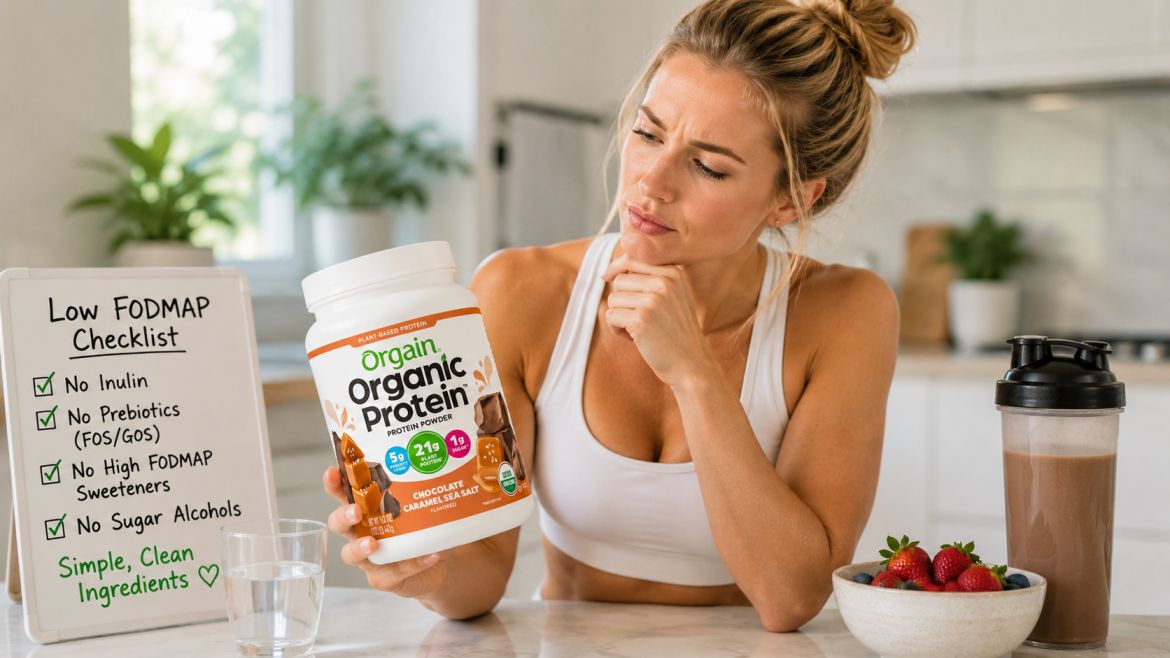
The vanilla bean flavor of Orgain’s flagship Organic Plant-Based Protein Powder contains organic agave inulin fiber. Inulin is a fructan. Fructans are a confirmed FODMAP group. According to the Fig App’s Orgain Organic Protein Powder FODMAP analysis, This product has 9 ingredients that are high FODMAP and 31 ingredients that may be high FODMAP.
Inulin is not an accidental contaminant in this formula. Orgain includes it deliberately as a prebiotic fiber to support digestive health, which is a reasonable formulation choice for the general population. For someone in the FODMAP elimination phase, that same selling point is a direct gut trigger. The fact that the inulin is sourced from organic agave does not alter its FODMAP classification at all.
Orgain Ready-to-Drink Protein Shakes: Why the Chocolate Version Is Even Riskier
The Orgain Plant-Based Protein Shake in chocolate carries a more complex ingredient profile than the powder. The Fig App’s analysis flags eight ingredients that may be high FODMAP,
Many of these ingredients carry individual FODMAP concerns on their own. Combined in a single serving, the cumulative FODMAP load becomes significant. During the elimination phase, that level of compounded uncertainty is reason enough to remove the product from consideration entirely.
Is There Any Orgain Product That Is Low FODMAP?
Orgain’s Keto Collagen Protein appears on some low-FODMAP product lists compiled by registered dietitians and does not contain inulin or obvious prebiotic fiber additions. That said, no Orgain product has been formally certified by Monash University or FODMAP Friendly, the two testing bodies whose laboratory analysis provides confirmed safety data. Without certification, no Orgain product can be recommended with full confidence for the elimination phase. Formulations also change without notice, so reading the current label on every purchase is non-negotiable.
Is Whey Protein Isolate Low FODMAP? A Cleaner Option Worth Knowing About
If you are not committed to a fully plant-based approach, whey protein isolate is the most practical low FODMAP protein powder option available.
The distinction between isolate and concentrate is critical. Whey protein concentrate retains between 4 and 8% lactose, which is high enough to trigger symptoms in sensitive individuals. Whey protein isolate does not carry the same risk at standard serving sizes.
When choosing a flavored whey isolate, read the label carefully for added sweeteners, specifically sorbitol, xylitol, honey, and agave, as well as any prebiotic additions like inulin or FOS. Those additions convert a safe protein base into a high-FODMAP product.
Certified low FODMAP whey isolates currently include Stellar Labs Whey Protein and Casa de Sante’s Elemental Whey WPI. If you are evaluating Orgain alongside these alternatives from a weight management angle, this analysis covers whether Orgain protein powder is good for weight loss and helps frame the comparison.
Low FODMAP Vegan Protein Options That Are Actually IBS-Safe
Not using whey is a completely valid position. Certified plant-based alternatives exist for low fodmap vegan protein needs, and they are more accessible than most IBS dieters realize. The key is choosing products that have been formally laboratory-tested rather than relying on label reviews alone.
Pea protein isolate is considered low FODMAP at a serving size of approximately 75 grams per meal, according to Monash University. The isolate form matters here. Processing removes most of the galacto-oligosaccharides that make whole legumes a FODMAP problem, leaving a significantly cleaner product. Brown rice protein is also considered safe at standard serving sizes. Both are reliable foundations for anyone managing IBS on a plant-based diet.
Certified options include Better Blends Vegan Protein, Vitessence Pulse 1803, and several other pea protein isolate products that have earned formal certification. When shopping at Walmart, Target, or Amazon, scan two things immediately: no inulin listed anywhere, and no prebiotic fiber in any form. Those two ingredients alone disqualify the majority of mainstream plant-based protein powders from the running. For a more complete picture of what Orgain delivers beyond the FODMAP question, the full review here is a useful reference before you decide.
How to Read Any Protein Powder Label for FODMAP Safety
This section is worth saving for your next shopping trip. You can apply this checklist to any protein powder brand, at any store, without an app.
Start with the protein source. Whey protein isolate is your cleanest animal-based starting point. If the label says “whey protein concentrate” without the words “lactose-free,” leave it. For plant-based options, pea protein isolate and brown rice protein are your safest bases.
Then scan the ingredient list for these specific red flags:
- Inulin, chicory root fiber, or agave inulin fiber all are fructans and confirmed FODMAPs regardless of how they are sourced
- Fructose, honey, agave syrup, or apple powder high-FODMAP sweeteners and natural flavoring sources that show up frequently in “clean” products
- FOS or GOS prebiotic fibers that belong to confirmed FODMAP categories
- Sorbitol, xylitol, mannitol, or maltitol any sweetener ending in “-ol” is a polyol and high FODMAP
- Large fruit or vegetable blends cumulative FODMAP load from multiple borderline ingredients adds up fast, even when each item looks minor individually
If a product clears all five, take one final step. Confirm that the serving size you actually use matches the amount that was tested. A pea protein isolate that is low FODMAP at 75 grams can exceed safe thresholds at double the portion. Quantity matters as much as ingredients do.
Conclusion
Managing IBS on the low FODMAP diet is demanding enough without a protein powder quietly undoing your progress. Orgain builds good products, but the plant-based line is formulated around prebiotic inulin fiber, an ingredient that is high FODMAP by definition regardless of how cleanly it is sourced. That is not a labeling error or an oversight. It is a deliberate formulation choice aimed at the general gut health market, not the IBS elimination phase.
Certified alternatives exist, are widely available, and do not require you to compromise on protein quality or your dietary values. If you want a clearer picture of what Orgain is actually delivering before you switch, this breakdown examines whether Orgain protein powder is genuinely healthy for different populations and goals.
Your elimination phase is worth protecting. The right protein powder choice makes it significantly easier to get accurate, actionable results.
What protein powder has worked best for you on the low FODMAP diet? Drop it in the comments real-world feedback matters more than any label.
Frequently Asked Questions
Which protein powders are low in FODMAP?
Whey protein isolate and egg white protein are the most reliably low-FODMAP animal-based options at standard serving sizes. For plant-based choices, pea protein isolate at approximately 75 grams and brown rice protein are considered low FODMAP according to Monash University testing. The safest approach is to prioritize products formally certified by Monash University or FODMAP Friendly, as certification requires laboratory analysis rather than label review alone.
Is Orgain ok for IBS?
Orgain’s plant-based protein powders contain organic agave inulin fiber, a confirmed fructan FODMAP, making them unsuitable during the low FODMAP elimination phase. If you have IBS and are not currently in a formal elimination phase, individual tolerance may vary depending on your specific FODMAP sensitivities. Consult your doctor or a FODMAP-trained dietitian before adding any protein supplement to your routine, particularly if your symptoms are not yet well-managed.
Is Orgain organic plant-based protein powder low FODMAP?
No. Orgain Organic Plant-Based Protein Powder contains organic agave inulin fiber, which is a fructan and a confirmed FODMAP. FODMAP scanning tools including the Fig App flag the vanilla bean flavor with one confirmed high-FODMAP ingredient and four additional potentially problematic ingredients at a standard serving. This product is not appropriate for use during the low FODMAP elimination phase, regardless of its organic certification.
Is pea protein isolate low FODMAP?
Yes, pea protein isolate is considered low FODMAP at a serving of approximately 75 grams according to Monash University research. The isolate form is critical here, as processing removes most of the galacto-oligosaccharides that make whole peas and legumes high FODMAP. Always verify that your pea protein product does not include added inulin, prebiotic fiber, or high-FODMAP sweeteners such as agave, honey, or fruit powders, as these additions change the FODMAP status of the final product.
Can I use protein powder during the low FODMAP elimination phase?
Yes, but ingredient selection is essential. The elimination phase requires removing all high-FODMAP ingredients, including hidden ones in supplements and protein powders. Stick to products certified by Monash University or FODMAP Friendly during this phase, or choose simple unflavored whey protein isolate or pea protein isolate with a clean label, no added prebiotic fibers, no fruit or vegetable blends, and no sugar alcohols. Check the current label on every purchase, as formulations can and do change.