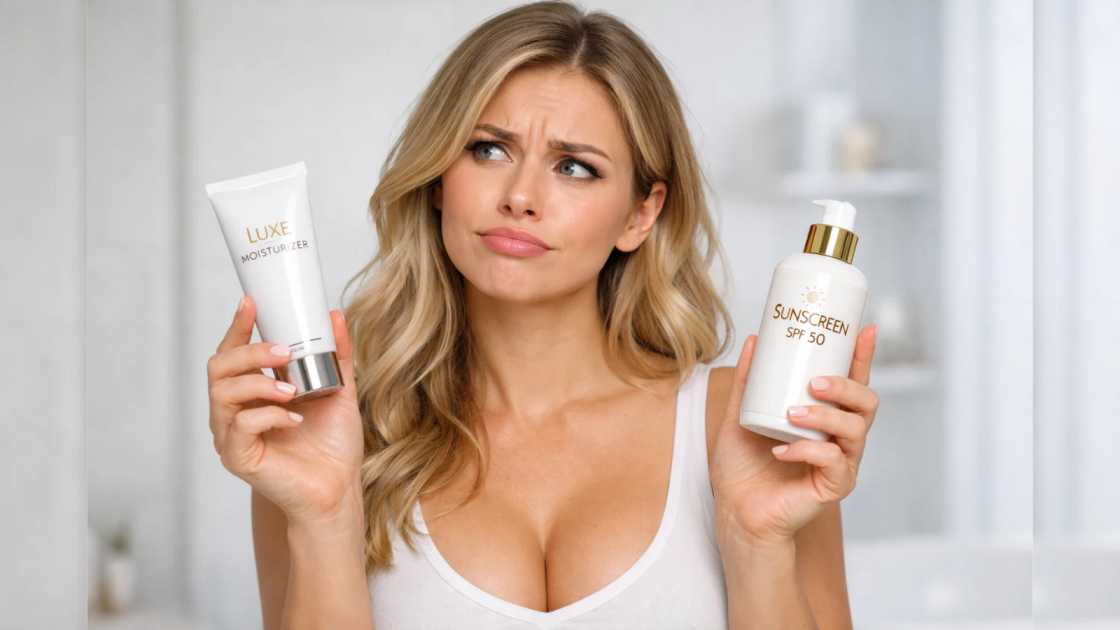
You’re standing in front of your bathroom mirror with moisturizer in one hand and sunscreen in the other, wondering which goes on first without messing up your routine. Getting the sunscreen or moisturizer first order wrong reduces product effectiveness, potentially leaving your skin unprotected from UV damage.
This guide explains exactly the moisturizer before sunscreen or after, why the order matters, and can I use sunscreen as moisturizer to simplify your routine. You’ll discover primer or moisturizer or sunscreen first when adding makeup, and how long after moisturizer to apply sunscreen.
By the end, you’ll know whether you put sunscreen on before or after moisturizer based on your products, whether the sunscreen is a moisturizer, and the exact wait times between layers.
Sunscreen or Moisturizer First and What’s the Right Order Really
Sunscreen or moisturizer first? Apply moisturizer first, wait 1-2 minutes, then apply sunscreen as your final skincare step. This sequence allows moisturizer to hydrate without interfering with sunscreen’s protective film. Sunscreen creates a barrier on your skin’s surface applying moisturizer on top dilutes this protection and reduces SPF effectiveness.
Chemical sunscreens containing avobenzone or octinoxate need direct contact with skin to absorb UV rays. Applying moisturizer first creates a hydrated base that doesn’t prevent penetration. Physical sunscreens with zinc oxide or titanium dioxide sit on the skin’s surface to reflect UV rays, so they must be your final layer.
According to the studies, the correct order is cleanser, toner, serum, moisturizer, then sunscreen. This layering ensures each product performs its function. Breaking this sequence especially by applying moisturizer before or after sunscreen in the wrong order compromises sun protection.
Is Sunscreen a Moisturizer or Are They Two Different Things
Is sunscreen a moisturizer? No, sunscreen and moisturizer serve different purposes. Sunscreen protects skin from UV radiation, while moisturizer hydrates and repairs your skin barrier. Although some sunscreens contain moisturizing ingredients like hyaluronic acid, they don’t provide adequate hydration for most skin types.
Sunscreen formulations prioritize sun protection. The active ingredients/chemical filters or mineral blockers occupy most of the formula, leaving limited space for hydrating agents. Moisturizer dedicates its entire formula to hydration through ingredients like ceramides and fatty acids.
The FDA regulates sunscreen as an over-the-counter drug because it prevents disease (skin cancer). Moisturizer is classified as a cosmetic. Research from the National Library of Medicines shows that sunscreen reduces squamous cell carcinoma risk by 40% when used daily benefits moisturizer alone cannot provide. Hybrid “moisturizers with SPF” often contain lower sunscreen concentrations (SPF 15-30) compared to dedicated sunscreens (SPF 30-50+).
People also read: Cerave Daily Moisturizing Cream Ingredients & Safety Review
Can I Use Sunscreen as Moisturizer and Skip One Step Instead
Can I use sunscreen as moisturizer? It depends on your skin type. People with oily or combination skin might find some sunscreens hydrating enough to skip separate moisturisers. Dry or mature skin typically needs a dedicated moisturizer.
Modern sunscreens contain hydrating ingredients like niacinamide, hyaluronic acid, and squalane. Products like La Roche-Posay Anthelios or EltaMD UV Clear offer enough hydration for oily skin to skip moisturizer.
This approach works only if you’re applying the full recommended amount about ¼ teaspoon for your face. Most people under-apply sunscreen. If you’re relying on sunscreen for both protection and hydration, you must apply enough product. Oily skin produces excess sebum, making additional moisturizer optional. Dry skin needs the hydration layers that moisturizer provides. Can you put moisturizer over sunscreen? Nothing disrupts the protective layer.
Primer or Moisturizer or Sunscreen First for Your Makeup Routine
Primer or moisturizer or sunscreen first? The correct order is moisturizer, sunscreen, primer, then makeup. This ensures proper hydration and sun protection before cosmetics. Primer goes after sunscreen because its purpose is to create a smooth makeup base.
Wait 5-10 minutes after sunscreen before applying primer. This allows the sunscreen to set and form its protective film. Rushing causes products to mix, diluting sun protection and creating pilled texture.
Choose primer based on your sunscreen formula. If you use a matte sunscreen, pair it with a hydrating primer. If your sunscreen feels greasy, use a mattifying primer. Some modern sunscreens contain primers built into their formulas, eliminating the need for a separate product.
How Long to Wait Between Moisturizer and Sunscreen Application
How long after moisturizer to apply sunscreen? Wait 1-2 minutes for lightweight moisturizers and 3-5 minutes for rich creams. This brief pause allows moisturizer to absorb partially, creating an ideal base for sunscreen. Waiting too long (10+ minutes) causes full absorption, but waiting too little causes products to mix and pill.
Wait time depends on moisturizer texture. Gel-based moisturizers absorb within 60-90 seconds. Cream-based moisturizers need 3-5 minutes. Your skin should feel hydrated but not wet or tacky when you apply sunscreen.
Climate affects absorption. Humid environments slow absorption extend wait time by 1-2 minutes. Dry climates accelerate absorption. Do you put sunscreen on before or after moisturizer also affects how long you wait after sunscreen before makeup. Chemical sunscreens need 15 minutes to bind with skin. Physical sunscreens work immediately but benefit from 5 minutes of setting time.
FAQs
Should I apply sunscreen before or after moisturizer at night?
Don’t apply sunscreen at night you only need sun protection during daylight hours. At night, apply moisturizer or night cream as your final skincare step. Save sunscreen for morning routines.
Can I mix sunscreen with moisturizer to save time?
Mixing sunscreen with moisturizer dilutes the SPF and compromises protection. Studies show mixing reduces effectiveness by 25-50%. Apply products separately in the correct order, moisturizer or sunscreen first doesn’t change.
Does moisturizer reduce sunscreen effectiveness if applied after?
Yes, applying moisturizer before or after sunscreen in the wrong order (moisturizer after sunscreen) reduces SPF effectiveness by 15-30%. The moisturizer disrupts the protective film. Always apply moisturizer first, then sunscreen.
What if my sunscreen pills when I apply it over moisturizer?
Pilling occurs when products contain incompatible silicones or when moisturizer hasn’t been absorbed. Wait 3-5 minutes after moisturizer application, use less product, or switch to a silicone-free sunscreen. Pat sunscreen onto skin instead of rubbing.
Can I skip moisturizer if I’m using hydrating serum?
Serum plus sunscreen might provide adequate hydration for oily skin, but most skin types need moisturizer’s occlusive ingredients. Try it for a week if your skin feels tight by midday, add back moisturizer before sunscreen.
Conclusion
Sunscreen or moisturizer first? Always apply moisturizer first, wait 1-5 minutes, then apply sunscreen as your final skincare step. This order ensures proper hydration while maintaining full sun protection. The sequence never changes regardless of your skin type or climate.
Can I use sunscreen as a moisturizer? Only if you have oily skin and use a hydrating sunscreen formula. Most skin types need separate moisturizer and sunscreen for adequate hydration and protection. Combination products compromise on both functions.
Start your routine tomorrow following this exact order: cleanser, toner (optional), serum (optional), moisturizer, wait 2 minutes, sunscreen, wait 5 minutes, primer (if using), then makeup. Set a timer for the wait times until the routine becomes automatic.